top of page

Barrow Street Loft
Loft in a Herring Factory in Manhattan


1/5

Built in 1920, the building was originally a herring canning factory back when the far West Village was an industrial port. The large wall of windows and 12 ft ceilings remained, but the open spaces had been converted into Co-op apartments in the late 80’s by architect Cy Winthrop (who lived out his remaining years in this very unit!) Cy’s labor of love completely obscured the original structure with smoky mirrored walls, laminate everything and a small koi pond in a corner of the living room.


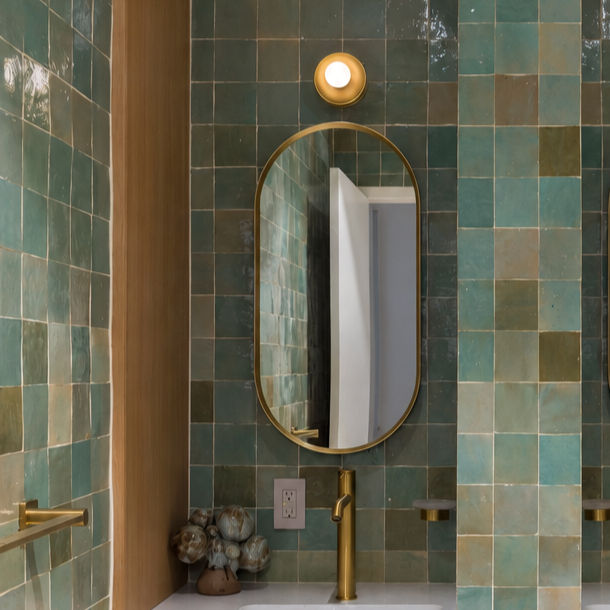


Enter Studio Vural, tasked with creating an open “party” space with 2 flexible “bedrooms”, a playful loft space, a primary suite, and a nod to the client’s love of mid-century modern furniture and art. We exposed the original concrete columns and beams and managed to save the 80’s parquet floors and (some) cabinetry. We added contemporary elements such as earthy cement tiles, acoustic felt panels and glass blocks in warm wood.
Below are historical photos that date back to the 1920's and the buildings use as a canning factory. The mushroom column was an invention of its time that found its final form in the bracket columns which we exposed in our project.


1920's
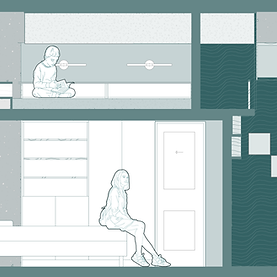
There were major challenges, one of which was the repair of peeling concrete surfaces. We researched custom mixtures of pigment, concrete and resin that would bond well yet look authentic. Another challenge was to fit multiple rooms into such a limited space. All volumes had to be precise in proportion, scale and position in all datums; a 3-D puzzle with no margin of error.


We think of the design as “pods in a box” with a home office/flex bedroom, a loft reading area, and a sleeping nook nestled in a large shell. The pods are clad in oak and green felt and lit through transom windows. Large glass blocks provide additional light and a sense of openness. We designed custom built-in furniture with hidden storage to maximize the space while providing sofa seating for eight.


Starting with the Vita Herring Factory, our design unveils layers of architectural history and creates a new chapter by contemporizing historic elements. On the exact same concrete slab of this iconic building, a new family, a new life, a new architecture come into being.



Principal Architect
Selim Vural, AIA
Project team
Efecan Zeybek
Ceren Kalayci
Art Director / Ceramics
Kerry Robertson
Photographs
Kate Glicksberg
General Contractor
Don Kwok & Crew
See project on:


Year
2026
Phase
Completed
Share project on:
bottom of page